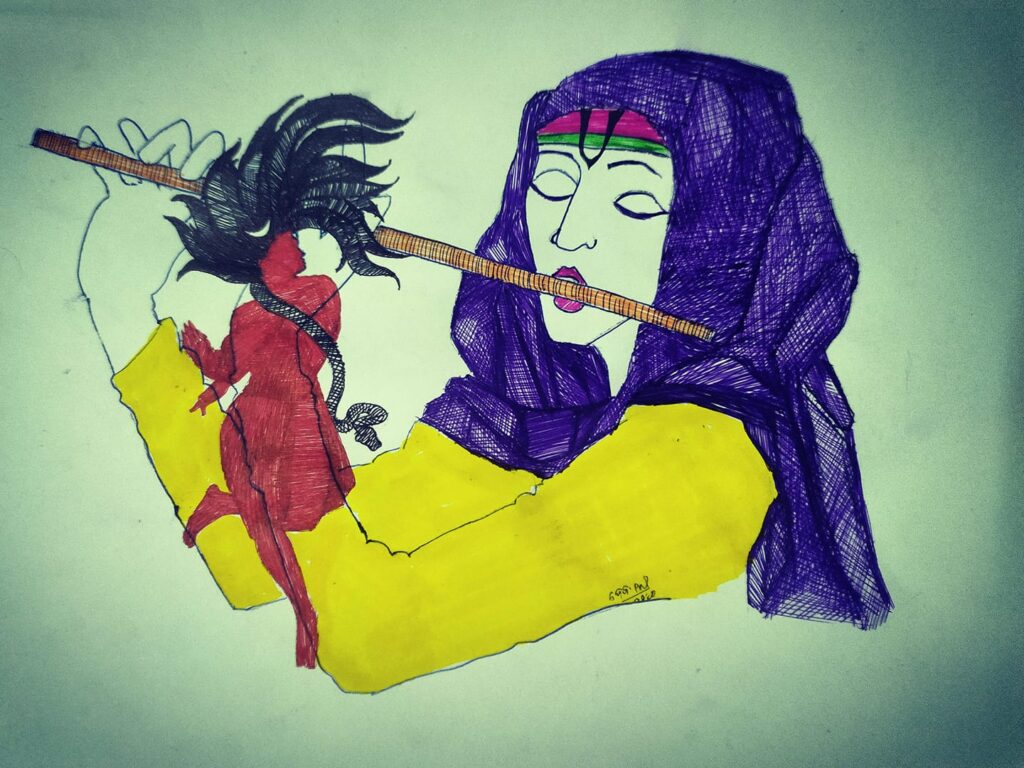
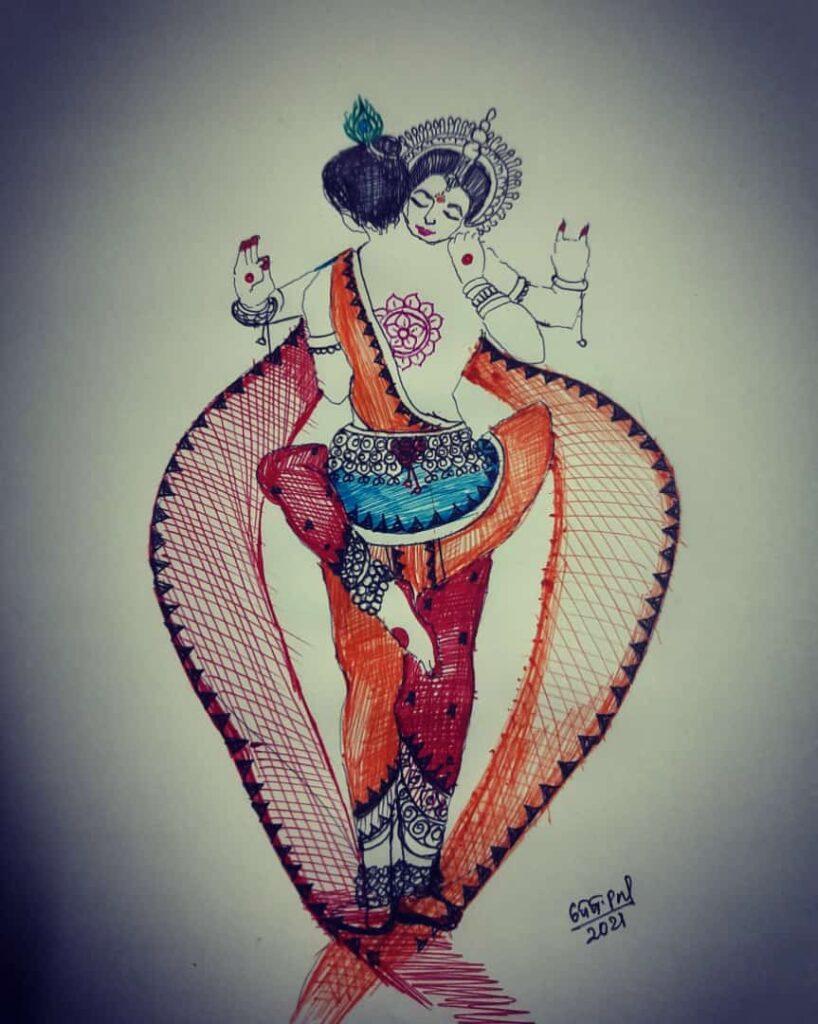
What is Chitravinaya? Its not a painting of pure imagination, instead a fusion of raag dance and colours. Raags have individual colours and are also figurative, described in Visnu Tarmouta, many Puran and Upanishads. Hand movements in dance and postures portray a feeling which could be “hi how are you?” which can be translated along with the raag colours as an image.
Ragamala
An important historical example of Chitravinaya’s roots are, the Ragamala paintings, a form of Indian miniature painting, depicting various ragas. In the Ragamal paintings raags are brought to visual life, personified by colour, mood, a visual verse of a story. it also implies the season and the time of day and night in which a particular raga is to be rendered. The paintings depict not just the Ragas, but also their wives, (raginis), their numerous sons (ragaputra) and daughters (ragaputri). Most paintings also have specific Hindu deities attached with the raga, like Bhairavi to Shiva, Sri to Devi etc.
Ragaputra Velavala of Bhairava – circa 1500
Ragmala or Ragamala is the title of a composition of twelve verses, running into sixty lines that names various ragas which appears in most copies of the Guru Granth Sahib after the compositions of Guru Arjun Dev entitled “Mundaavani” (The Royal Seal). In many of the older copies of the Guru Granth Sahib, Ragmala appears at the end after other compositions which added by various scribes but later deemed unauthorised by Sikh Panth (nation).
The title literally means a ‘garland of Ragas, “Mala” means “garland”, It gave rise to the series of Ragamala paintings. This list differs according to the author and the music school it is based upon. Ragamala paintings are a form of Indian miniature painting, a set of illustrative paintings of the Ragamala or “Garland of Ragas”, depicting variations of the Indian musical modes called ragas. They stand as a classical example of the amalgamation of art, poetry and classical music in medieval India.
Ragamala paintings were created in most schools of Indian painting, starting in the 16th and 17th centuries, and are today named accordingly as Pahari Ragamala, Rajasthan or Rajput Ragamala, Deccan Ragamala, and Mughal Ragamala.The six principal ragas present in the Ragamala are Bhairava, Dipika, Sri, Malkaunsa, Megha and Hindola and these are meant to be sung during the six seasons of the year – summer, monsoon, autumn, early winter, winter and spring.
Chitravinaya, Raag Citra, classical dance and so many other related art forms have their roots in ancient treatise and scriptures. ICM being a fulcrum beetwen them, and plays an essential part of the rendered visulisation. here below are some of the Ragamala paintings.
Hindola raaga – Ragamala
Depak raaga – Ragamala
Lalita raaga – Ragamala
Shree raaga – Ragamala
Pancham Ragini – Ragamala
VST Archive
In accordance to our mission at ICMACY, we aim to archive not only Music but also ICM related arts. As an example to this deeply emtional and beautiful art form we start with an unique collection of sketches and storys from our mentor in this feild Debabrata Pal.
Raag Bageshree – Debabrata Pal
Poet kalidash – Debabrata Pal
Raag Bhairavi – Debabrata Pal
Raagni – Debabrata Pal
Raag Durga – DebabrataPal
Story of Stree Heemagini – Debabrata Pal
Raag Dhrupad- Debabrata Pal
Derived from: Shiva & Shakti – The Divine Union of Consciousness and Energy.